How to Feel — A book by Michael Donnell
There is a difference between knowing your feelings and actually feeling them.
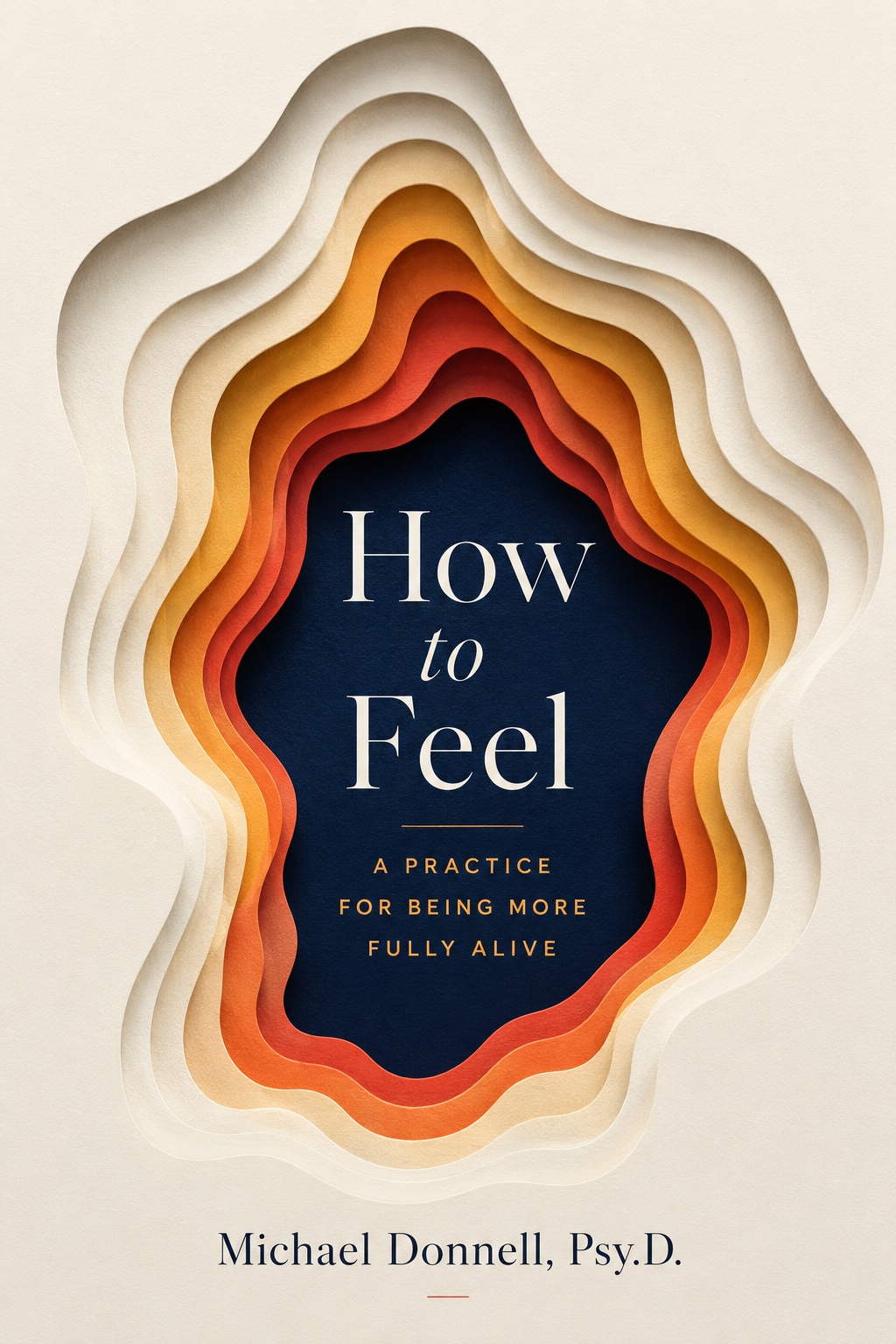
How to Feel — A book by Michael Donnell
Some have spent years in therapy, or in serious self-reflection, developing real self-awareness — and still find that in the moments that matter most, something closes. The feeling they can describe so fluently remains somehow just out of reach.
Others have watched themselves move through their closest relationships on autopilot, present to the shape of the conversation but not to the person in front of them — and known, somewhere, that this is not what they want.
Some have simply lived with a low-level sense of numbness, a feeling that life is passing at a slight remove: present enough to function, but not quite fully inhabited.
What these experiences share is not a failure of effort or intelligence. It’s that understanding our feelings and actually feeling them are different skills, and most of us were never taught the second one.
From the book
What I failed to understand, for longer than I care to admit, was that learning to feel is not preparation for living; it is living, and the two are finally, irreducibly the same thing.
The heart, it turns out, is not a selective instrument. It cannot be tuned to receive only joy while filtering out sorrow, cannot be calibrated to let in love while keeping out fear.
— How to Feel
Most books about emotional life offer insight: an account of where your patterns come from and what they mean. This one begins from the suspicion that insight, however true, has not been enough. You can understand exactly why you do what you do and still find yourself doing it, still unable to reach the feeling underneath. That gap is not a failure of will or intelligence. It is a skill that was never taught.
How to Feel treats feeling as that skill. Drawing on somatic traditions and the science of how the body senses its own states, it describes how emotions actually move through us, why they so often stall before they finish, and what it takes to stay with them long enough to feel them through. The capacities it lays out build on one another: noticing sensation, letting it move, finding ground, staying when everything in you wants to leave.
It is not a program or a set of techniques to apply. It is a practice for becoming more fully alive to your own experience, which turns out to mean feeling more of everything, not only the parts you would choose. What it offers is a clearer sense of why the usual approaches leave something untouched, and a description, written from inside the same difficulty, of what becomes available when you stop managing your experience and begin to inhabit it.
For years I thought the problem was that I didn’t understand myself well enough. I was a psychologist by training, already years into the work, and I had done a great deal of my own. I could name my feelings. I could explain where they came from. And still, when it mattered most, I couldn’t quite reach them. I remember a particular afternoon with my own sadness, unable to feel it directly, watching myself either performing it or sliding into something that felt more like wallowing, and asking a question I did not know how to answer: how do I actually feel this?
It took years to find an answer. When I did, it came not from my academic training but from teachers working in the body, in traditions that turned out to be teachable, practical, and nothing like what I had been led to expect. What I learned from them became the material of this book.
How to Feel is the book I wish I had found earlier. I wrote it for my clients, and for anyone who has come up against the same question I did, and wondered where to go next.
Credentials
Michael Donnell is a licensed psychologist with two decades of clinical practice and extensive training in somatic and body-based approaches.
Be first to hear
How to Feel arrives November 2026. Leave your address and I’ll write when the book is out. Nothing before then, nothing after.
Infrequent. Unpromoted. Easy to leave.